The Seated Wheelchair Row That Helps Adaptive Athletes' Shoulder Pain
Strength shows up in three forms this month. There’s the kind you build one rep at a time in a chair with a band. There’s the kind that breaks a Paralympic record in front of the world. And there’s the kind that gets written into a federal grant program big enough to fund a year of recovery for thousands of veterans.
This issue covers all three. We walk through the seated resistance band row, a foundational pulling movement every adaptive athlete should train. We look at what Declan Farmer did at Milano Cortina 2026 and why 26 points in five games should change how people talk about sled hockey. And we examine the $16 million in adaptive sports grants the Department of Veterans Affairs announced in April: who benefits, and where the model still falls short.
One movement. One athlete. One funding cycle. The same principle ties them together: real change is not a metaphor. It is built.
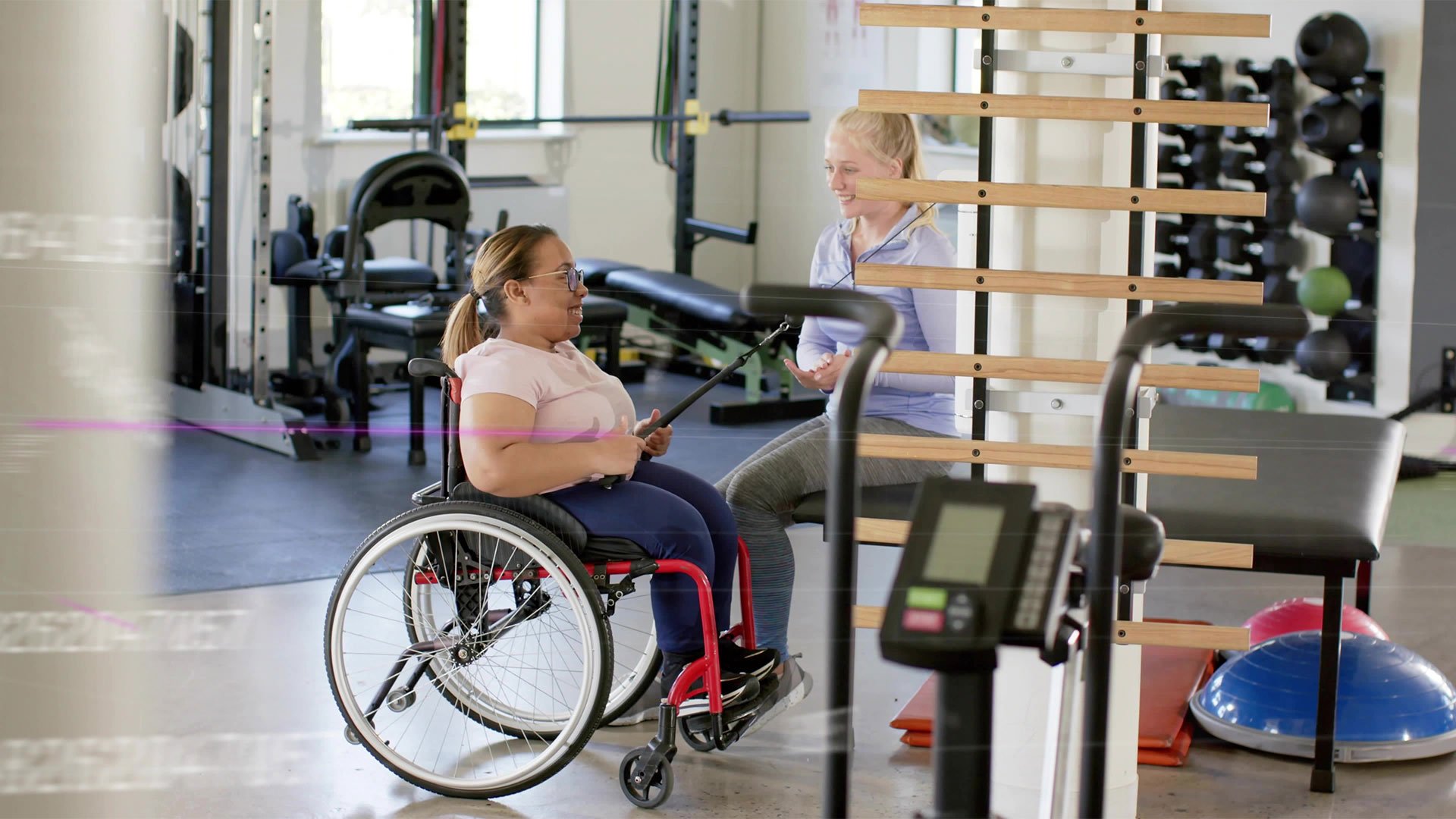
The Seated Resistance Band Row: A Foundational Pulling Movement for Adaptive Athletes
The seated row is one of the most useful upper body movements an adaptive athlete can train. It builds posture, it builds pulling strength, and it does it from a chair with a piece of equipment that costs less than a tank of gas. For wheelchair users in particular, the row is one of the few movements that directly counterbalances the constant pushing demands of daily life.
How the Movement Works
Anchor a resistance band at chest height. A door anchor, a sturdy pole, or a partner holding the band all work. Sit upright with feet flat if the athlete has that option, or stable in the wheelchair with brakes locked. Grip both ends of the band with arms fully extended. Pull the handles toward the lower ribs by driving the elbows back and down. The shoulder blades should retract together, as if pinching a pencil between them. Pause briefly at the end range, then release the band back to the start position under control.
The chest stays open through the pull. The torso does not rotate. The neck stays neutral. The work is done by the mid back, rear shoulders, and biceps, in that order of priority.
Programming Considerations
Two to three sessions per week is the working range. Three to four sets of eight to twelve repetitions is a standard starting point for hypertrophy and posture, with the load adjusted by selecting a heavier or lighter band. The movement scales easily. A lighter band for athletes recovering from injury or new to training. A heavier band, or doubling up two bands, for athletes ready to push intensity.
Common coaching cues: lead with the elbows, not the hands. Pinch the shoulder blades. Keep the rib cage down. Do not let the head poke forward at the end of the pull.
Contraindications are limited but real. Recent shoulder surgery, acute rotator cuff injury, or unstable seating positions all warrant a coach's review before adding load.
Why This Movement Matters for Adaptive Fitness
For adaptive athletes who use a wheelchair, the daily mechanics of life create predictable imbalance. Pushing forward, reaching forward, transferring forward. The shoulders round. The chest tightens. The mid back goes silent. The seated row is the corrective answer to that pattern.
The benefits show up in research, not just in coaching folklore. A 24-week elastic band exercise program for wheelchair-using older adults produced measurable gains in handgrip strength, muscle endurance, lung capacity, and independence in daily living tasks (Hsieh et al., 2023). Those are not vanity metrics. Handgrip strength alone is one of the most reliable predictors of mortality risk in older adults, and it tracks closely with overall upper body strength (Bohannon, 2019).
For adaptive athletes specifically, the row also protects the rotator cuff. Wheelchair propulsion places repeated demand on the front of the shoulder. Without dedicated pulling work, the shoulder joint develops a strength asymmetry that drives chronic pain and rotator cuff injury over time. The row reverses that math.
Hsieh, P. L., et al. (2023). Effects of chair-based resistance band exercise on physical functioning, sleep quality, and depression of older adults in long-term care facilities. International Journal of Environmental Research and Public Health. https://pmc.ncbi.nlm.nih.gov/articles/PMC9969069/
Performance Health. (2026). Resistance Band Exercises for Wheelchair Users. https://www.performancehealth.com/articles/resistance-band-exercises-for-wheelchair-users
Challenged Athletes Foundation. (2026). Adaptive Fitness Techniques For At Home Or The Gym. https://www.challengedathletes.org/adaptivefitnesstechniques/
Declan Farmer Rewrote the Paralympic Sled Hockey Record Book
Declan Farmer scored 15 goals and 11 assists in five games at Milano Cortina 2026. That is 26 points. It is the most points anyone has ever scored at a single Paralympic Winter Games in sled hockey. He was named the tournament's Most Valuable Player, voted Best Forward by the directorate, and chosen as Media Best Player by the press covering the event (International Paralympic Committee, 2026).
He is 28 years old. He is now the all-time leading scorer in Paralympic sled hockey history.
The numbers matter, but the way Farmer played mattered more. Across the gold medal game against Canada, the United States won 6 to 2, and Farmer's stat line tells the story of a player who controlled the ice. He scored. He set up linemates. He finished the tournament as the engine of a team that has now won five consecutive Paralympic gold medals (NBC Olympics, 2026).
That fifth straight gold is its own headline. No nation in Paralympic sled hockey history had won five in a row before Milano Cortina. The U.S. did it by beating Canada in front of a sold-out crowd, and Farmer was the player Canada could not solve.
There is a tendency in sports media to talk about adaptive athletes as inspiring. The framing is gentle. The framing is also wrong. Farmer is not an inspiration. He is the best player in his sport, and his sport happens to be one most people never bothered to watch. The IPC's coverage at Milano Cortina drew record digital engagement, with more views and more streamed minutes than any previous Winter Paralympics, which suggests the audience problem is closing on its own (International Paralympic Committee, 2026b).
Farmer was also elected to the IPC Athletes' Council as a Winter Athlete Representative during the Games, a role that puts him at the table for decisions about how the Paralympic movement is run (USA Hockey, 2026). The same player who set the points record is now helping shape the rules and access policies for the athletes who come after him.
Why This Athlete Matters for Adaptive Fitness
Farmer's run at Milano Cortina is what visibility looks like. A record-breaking performance, on a five-time gold medal team, in a sport that millions of Americans now know exists in part because of how he played. Visibility creates accessibility, and accessibility is what gets the next 14-year-old on a sled. Bloc Life's mission lives in that pipeline. The athletes we serve every day at our partner gyms are training because someone like Farmer made the path visible.
International Paralympic Committee. (2026, March 16). Declan Farmer named Milano Cortina 2026 MVP, Best Forward and Media Best Player. https://www.paralympic.org/news/declan-farmer-named-milano-cortina-2026-paralympic-mvp
NBC Olympics. (2026, March 15). U.S. skates to unprecedented fifth straight Paralympic sled hockey gold, beating Canada 6-2. https://www.nbcolympics.com/news/united-states-skates-unprecedented-fifth-straight-paralympic-sled-hockey-gold-beating-canada-6
USA Hockey. (2026, March). Declan Farmer Elected To IPC Athletes' Council as Winter Athlete Representative. https://teamusa.usahockey.com/news_article/show/1359554
The VA Just Put $16 Million on the Table for Adaptive Sports
On April 9, 2026, the Department of Veterans Affairs announced $16 million in grants for organizations that run adaptive sports programs for veterans and service members. Eligible organizations had until May 13, 2026 to apply. Since the program began, the VA has awarded more than $160 million through this grant cycle (Department of Veterans Affairs, 2026).
The grant funds activities most people would call recreation. Skiing. Cycling. Wheelchair softball. Archery. Hunting. Fishing. The reason that list reads so casual is also the reason the program works. Veterans recovering from injury are not looking to be treated as patients indefinitely. They are looking for ways to get outside, move their bodies, and do something competitive again. The grant exists because Congress and the VA both recognized that recreation is recovery.
The structure of the funding matters too. Veterans do not apply for the grant directly. Instead, the money goes to nonprofits, local governments, and tribal organizations that run programs at the community level (VA News, 2026). That keeps the funding close to the ground, where the work actually happens. It also means the grant's impact depends entirely on which organizations apply, which ones get funded, and how the resulting programs are designed.
This is where the model still has gaps. A program can be funded and still leave a veteran on the sidelines if the coaching staff has not been trained to work with adaptive athletes. Equipment without expertise is a half-solution. The $16 million can purchase sit-skis, hand-cycles, and wheelchair tennis chairs all day. It cannot, on its own, train the coach who will teach a recently paralyzed Marine how to actually use them.
That is the gap Bloc Life and our partner gyms work to close. Equipment matters. Funding matters. But the human infrastructure that turns a piece of equipment into a session that builds capacity is the part most people stop talking about once the press release goes out. We hope to see VA grant recipients invest in coaching education alongside the gear.
Why This Program Matters for Adaptive Fitness
The $16 million represents the largest single annual round in the program's history, and it lands at the same time that participation in VA-supported adaptive sports has crossed 20,000 veterans nationwide (Department of Veterans Affairs, 2026). The signal is that adaptive recreation has crossed from niche to standard of care. Bloc Life's stance has always been that real change requires structure, support, and accountability. A $16 million grant is structure. A trained coach in a partner gym is support. The veteran walking back through the door for a fourth, fifth, and sixth session is accountability. The system works when all three are present.
Department of Veterans Affairs. (2026, April 9). VA announces $16M in disabled Veterans' adaptive sports grants. https://news.va.gov/press-room/va-announces-16m-in-disabled-veterans-adaptive-sports-grants/
VA News. (2026, April). VA awards $16 million to help Veterans with disabilities participate in adaptive sports. https://news.va.gov/press-room/va-awards-16-million-to-help-veterans-with-disabilities-participate-in-adaptive-sports/
Grants.gov. (2026). VA Adaptive Sports Grant. https://www.grants.gov/search-results-detail/360391
About The Bloc Life Breakthrough Report
The Bloc Life Breakthrough Report exists to highlight and elevate positive stories and advancements in the veteran, first-responder, and adaptive-athlete communities that aren't always covered in mainstream media. We believe these stories deserve visibility, and the people behind them deserve recognition.
Have a Story We Should Feature?
Know about a breakthrough, achievement, or initiative in the veteran, first responder, or adaptive athlete community that deserves attention? Submit your story for consideration and help us spotlight the work that matters.
Disclaimer: Featuring a study, story, or topic in this report does not constitute endorsement, support, or recommendation of any particular product, method, claim, or course of action. The Bloc Life Breakthrough Report covers advancements and developments affecting Veterans, First Responders, and Adaptive Athletes strictly for commentary and discovery purposes. This content should not be construed as medical, nutritional, psychological, or professional advice, nor as factual claims or guidance. Bloc Life is not prescribing, diagnosing, promoting, or advising any course of action; we are simply sharing what we find relevant or meaningful to the communities we serve. This report exists under fair use for purposes of commentary, criticism, and analysis. Readers should consult qualified professionals before making changes to their health, fitness, mental wellness, or lifestyle practices. If you are an author, researcher, publisher, or rights holder of any content referenced in this report and would like to request updates, modifications, or removal, please contact us directly. Bloc Life is committed to accuracy, proper attribution, and respect for intellectual property.