The Seated Battle Rope Drill That Builds Conditioning Without Leaving the Chair
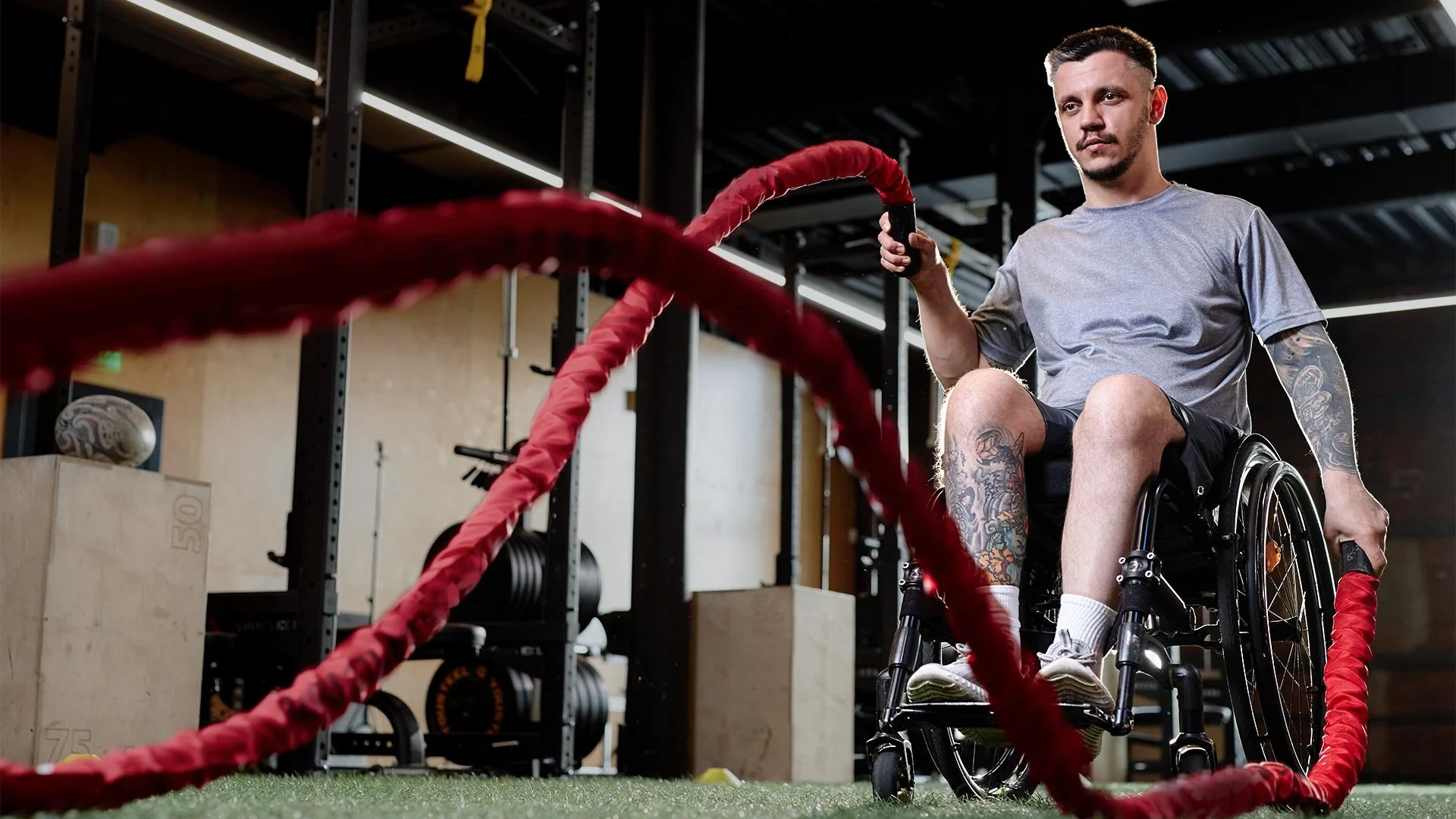
Conditioning is not supposed to disappear because an athlete trains from a chair. Too many training conversations make seated fitness sound like it has two options: slow strength work or generic mobility. That misses the middle ground where real athletic capacity gets built, the kind that raises the heart rate, challenges the lungs, and teaches an athlete to keep producing force under fatigue.
In this report, we break down the seated battle rope wave, a low-cost conditioning drill that can create serious upper body demand without requiring running, cycling, or standing. If you are an adaptive athlete, veteran, or first responder trying to build conditioning from a chair, this gives you a practical way to understand the movement, scale it, and know what to watch for. If you are a coach, friend, family member, or training partner helping someone else, it also gives you cues for setting it up safely and supporting the work without taking over the athlete's agency.
The point is not that every adaptive athlete should use battle ropes. The point is that adaptive fitness gets stronger when the workout changes to fit the athlete instead of asking the athlete to disappear from the workout.
The Seated Battle Rope Wave: A Conditioning Drill for Adaptive Athletes
The battle rope looks simple until the clock starts. Two handles. One anchor. Repeated waves driven by the shoulders, arms, trunk, and grip. For adaptive athletes, the seated version can create a real conditioning challenge without pretending that every person needs running, biking, or lower body rhythm to train their engine.
That matters because conditioning is one of the first things adaptive programs accidentally underdose. Strength is easier to visualize. Mobility is easier to scale. The seated battle rope wave gives the athlete a direct way to feel intensity, control posture, manage fatigue, and build capacity from a chair. A coach or training partner can help with setup and safety, but the athlete still owns the rhythm, effort, and decision-making inside the set.
How the Movement Works
Set the rope around a stable anchor point. Sit tall in a wheelchair, box, or bench position with the brakes locked if you are in a chair. Grip one rope end in each hand. Start with the shoulders down, the rib cage controlled, and the trunk braced. The rope should have enough slack to create waves, but not so much that you have to lean forward just to reach it.
If you are training with a friend, family member, or coach, have them check the anchor, chair position, floor space, and rope length before the set starts. Their job is not to do the work for you. Their job is to make sure the setup lets you train with control.
It goes like this: drive one hand down as the other hand rises, then switch as quickly as you can control. The goal is not to make the biggest wave possible. The goal is to make repeatable waves while the torso stays organized. The shoulders move, the elbows flex and extend, the grip stays active, and the trunk resists the urge to collapse forward.
Alternating waves are the standard starting point. Double-arm waves increase the bracing demand because both hands move together. Smaller waves at a faster cadence bias conditioning and rhythm. Larger waves at a slower cadence bias power and strength endurance.
How to Scale the Drill Without Guessing
Start with intervals, not long sets. A good entry point is 8 to 10 rounds of 10 to 15 seconds of work followed by 45 to 60 seconds of rest. The research protocol most directly relevant to seated rope work used 10 rounds of 15 seconds on and 45 seconds off, and it still produced a meaningful heart rate and oxygen consumption response (Brewer et al., 2018). That is the lesson: the set does not have to be long to be hard.
If you already have a strong conditioning base, progress toward 20 seconds of work or reduce the rest period. If you are new to the drill, keep the work short and protect quality. Once the torso folds, the neck reaches, the shoulders start to take over, or the waves flatten because you are grinding instead of moving with intent, the set is over.
Use simple checkpoints:
Can you keep your chair or seat stable?
Can you breathe while the rope is moving?
Can you keep your ribs controlled instead of folding forward?
Can you stop before shoulder discomfort becomes the main thing you feel?
Can you repeat the next round with similar control?
If the answer starts becoming no, that is useful information. Rest longer, shorten the interval, make the waves smaller, or stop for the day.
Safety and Setup Cues for Athletes, Family, and Coaches
The basic cues are simple: sit tall, lock the chair, keep the ribs down, move fast without shrugging, and stop before the shoulders take over completely. The rope should create conditioning demand, not joint punishment.
If someone is helping you, ask them to watch the things that are hard to feel once fatigue hits: chair movement, rope slack, shoulder shrugging, forward collapse, and whether the anchor stays secure. A good helper does not need to hype every rep. They need to help you keep the drill safe, repeatable, and honest.
Recent shoulder surgery, acute shoulder pain, unstable seating, uncontrolled blood pressure, or any condition where high-intensity upper body intervals are not appropriate should trigger qualified review before loading this drill. That does not make the movement off-limits for everyone. It means the right version has to match the athlete in front of it.
Why This Movement Matters for Adaptive Fitness
A 2018 study in the Journal of Strength and Conditioning Research compared seated and standing battle rope protocols and found that seated rope intervals reached about 71.87% of the subjects' cycling-tested VO2max, with the authors calling battling ropes a low-cost, accessible option for people who cannot stand or move their lower extremities rhythmically for aerobic exercise (Brewer et al., 2018). A later six-week battling rope HIIT study found improvements in upper body oxygen consumption and skeletal muscle strength, power, and endurance performance when battle rope intervals were programmed progressively (Bornath & Kenno, 2022).
Do not overclaim that research. The seated protocol was tested in healthy subjects, not specifically in Bloc Life athletes. The point is not that every adaptive athlete should do battle ropes. The point is that the seated rope wave gives athletes and the people supporting them a researched, scalable conditioning option when lower body cardio tools do not fit.
That is the Bloc Life standard. Systems should adapt to people, not the other way around. If you cannot run, the answer is not to skip conditioning. If you cannot safely use a bike, the answer is not to pretend strength training covers every energy system. The answer is to build a menu of tools that preserve the stimulus, respect the athlete, and make progress possible without requiring the body to fit someone else's template.
Brewer, W., Kovacs, R., Hogan, K., Felder, D., & Mitchell, H. (2018). Metabolic Responses to a Battling Rope Protocol Performed in the Seated or Stance Positions. Journal of Strength and Conditioning Research, 32(12), 3319-3325. https://pubmed.ncbi.nlm.nih.gov/30335722/
Bornath, D. P. D., & Kenno, K. A. (2022). Physiological Responses to Increasing Battling Rope Weight During Two 3-Week High-Intensity Interval Training Programs. Journal of Strength and Conditioning Research, 36(2), 352-358. https://pubmed.ncbi.nlm.nih.gov/32091465/
American Council on Exercise. (2020). The Relative Intensity and Energy Expenditure of Battle Rope Exercise. https://www.acefitness.org/continuing-education/certified/may-2020/7526/ace-sponsored-research-the-relative-intensity-and-energy-expenditure-of-battle-rope-exercise/
The Bloc Life Breakthrough Report: Deeper Insights for Everyone
Every report, we share real stories from the world of adaptive fitness, covering veterans, first responders, and the people and infrastructure that support them. There is no pity and no charity spin, only honest work, athletes giving their all, and the systems that help them succeed.
Have a Story We Should Cover?
Found a program, an athlete, or a piece of research the rest of the community should know about? We are always looking for stories worth telling. Submit your suggestions using the link below.
Disclaimer: Featuring a study, story, or topic in this report does not constitute endorsement, support, or recommendation of any particular product, method, claim, or course of action. The Bloc Life Breakthrough Report covers advancements and developments affecting Veterans, First Responders, and Adaptive Athletes strictly for commentary and discovery purposes. This content should not be construed as medical, nutritional, psychological, or professional advice, nor as factual claims or guidance. Bloc Life is not prescribing, diagnosing, promoting, or advising any course of action; we are simply sharing what we find relevant or meaningful to the communities we serve. This report exists under fair use for purposes of commentary, criticism, and analysis. Readers should consult qualified professionals before making changes to their health, fitness, mental wellness, or lifestyle practices. If you are an author, researcher, publisher, or rights holder of any content referenced in this report and would like to request updates, modifications, or removal, please contact us directly. Bloc Life is committed to accuracy, proper attribution, and respect for intellectual property.